
MTG Commander Power Level Calculator & Rule 0 Diagnostic Engine
Calculate your deck's mathematical power score (1.0–10.0). Measure tutor accessibility, mana velocity, and hypergeometric land consistency with tournament precision.
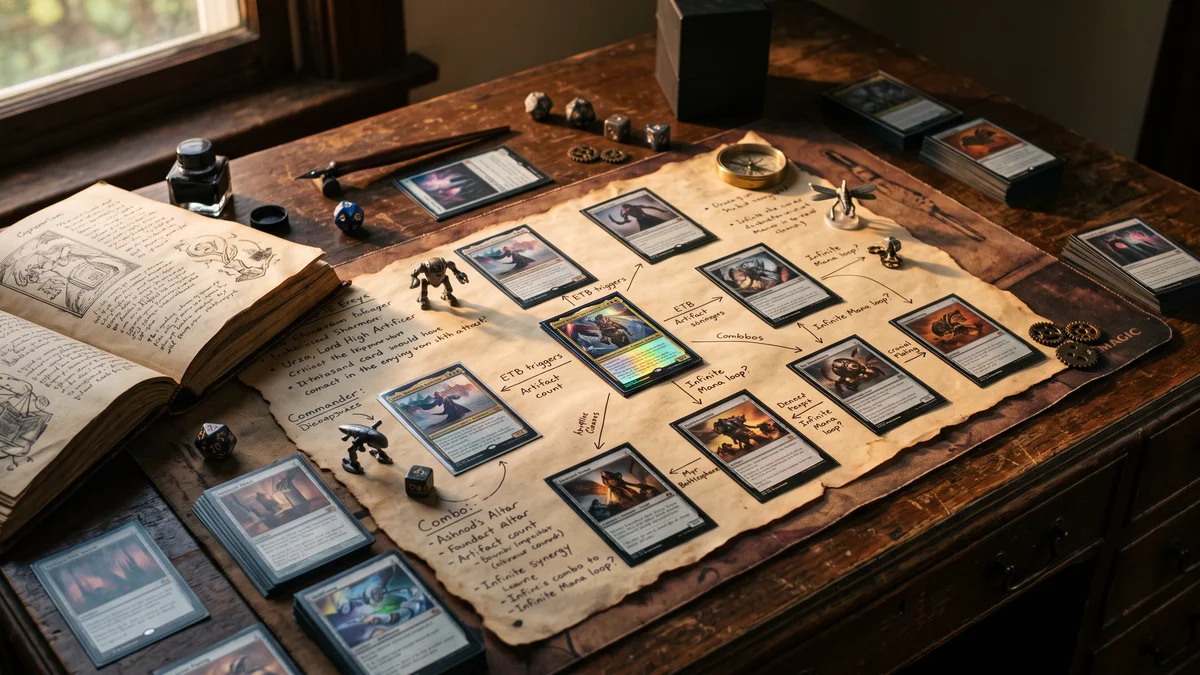
Interactive 1.0–10.0 Power Level & WotC 5-Bracket Decklist Auditor
Adjust fast mana rocks, tutor density, free counterspells, and average CMC to compute your objective power rating, projected lethal turn clock, and official WotC bracket tier.
100-Card Decklist Parser (< 80ms)
Paste your 100-card text export or load a benchmark preset. Client-side analyzer audits format legality, Game Changers, banned cards, color identity, and combo lines.
MTG Commander Power Level Calculator & Rule 0 Diagnostic Engine
Mathematical multi-factor calibration resolving the 'every deck is a 7' paradox.
Why Does 'Every Deck is a 7' and How Does Objective Scoring Work?
Our multi-factor auditing engine measures deck acceleration, non-land casting costs, and projected goldfish velocity. By examining these empirical data points, players obtain an objective rating that aligns tabletop expectations before starting the opening shuffle.
The notorious "Every deck is a 7" syndrome arises because human self-assessment conflates intent with capability. A player running a pet dragon theme may honestly consider their deck casual, yet if that deck includes Imperial Seal, Vampiric Tutor, and Sol Ring to find Worldgorger Dragon, its mechanical consistency and goldfish turn-clock match high-power pods.
Objective scoring isolates intent from math. By evaluating deterministic variables such as fast mana rocks, unconditional tutor density, average non-land converted mana cost, and two-card infinite combo lines, the algorithm outputs a reproducible metric. To align an entire 4-player table, use the CommanderMatchup pod balance and matchmaking engine. You can also browse commanders and color combinations or optimize deck synergy packages and ramp ratios.
Deterministic scoring eliminates post-game salt by establishing clear pre-game consensus. When players declare objective metrics—such as their average non-land CMC or turn-to-win pacing—pods can mutually decide whether to introduce high-interaction counters or switch to un-upgraded preconstructed decks. Calibrating table power before drawing opening hands preserves mutual respect and prevents the negative play patterns that plague unmoderated casual tables.
Furthermore, factoring in card velocity—the rate at which a deck sees additional cards through draw engines like Rhystic Study, Mystic Remora, or The One Ring—is essential for accurate power classification. Decks with high card velocity overcome variance far faster than linear battlecruiser builds, enabling consistent assembly of win conditions even under targeted spot removal. When combined with zero-mana countermagic like Pact of Negation, high-velocity decks dictate table tempo and demand dedicated counter-strategy from opposing players.
Hypergeometric Mana Curve Diagnostic: 3 Lands by Turn 3 Probabilities
Calculate the exact probability of hitting on-curve land drops using the multivariate hypergeometric distribution.
Hypergeometric Probability P(X >= k)
Variable Definition & Units
Total cards in library (99 cards for standard Commander).
Total land count in deck (typically 32 to 38 lands).
Cards seen (7 starting cards + turns drawn).
Desired minimum land threshold (e.g. 3 lands on curve).
Optimal for control and midrange commanders requiring consistent 5+ mana curve execution.
The casual golden ratio when supplemented by 8–10 two-mana acceleration rocks.
Aggressive curve. Requires 12+ zero-to-one mana rocks to prevent mana deprivation.
Pod Balance Spread Simulator & 4-Player Pre-Game Rule 0 Checklist
Walk through the interactive tournament judge decision tree to resolve pre-game Rule 0 conflicts and calibrate pod expectations before drawing starting hands.
Rule 0 Pre-Game Pod Diagnostic Engine
Interactive 4-player pod alignment, salt mitigation, and power-level calibration tree.
Frequently Asked Questions About Commander Power Level Calculation
How does the Power Level Calculator determine my score between 1.0 and 10.0?
The scoring engine computes a weighted multi-factor regression across four primary vectors: fast mana density (Sol Ring, Mox Diamond, Mana Vault), unrestricted tutor density (Demonic Tutor, Vampiric Tutor), free interaction density (Force of Will, Fierce Guardianship), and average non-land converted mana cost (CMC).
What is the probability of drawing 3 lands by Turn 3 in a 36-land Commander deck?
Using the hypergeometric distribution P(X >= 3) with population size N=99, sample size n=9 (7 starting cards + 2 draw steps on the play), and success states K=36, the probability is approximately 70.4%. Dropping land count to 32 reduces this probability to 60.6%.
What is an acceptable power level spread in a casual 4-player pod?
A delta of 1.0 or less (e.g., all decks between 5.5 and 6.5) produces balanced, competitive games where each player has an approximate 25% win equity. A delta exceeding 2.0 (e.g., an 8.5 deck against 6.0 decks) results in asymmetric dominance.
Does having Sol Ring automatically raise my deck above Bracket 2?
No. Sol Ring is a foundational staple printed in almost every preconstructed deck and is fully permitted in Bracket 2. However, stacking Sol Ring with Mox Diamond, Chrome Mox, and Ancient Tomb shifts the deck into Bracket 3 or 4.