
19 Colored Sources
78.7% no-mulligan (90% with mulligans) to cast Turn 1 mana dorks or cantrips on curve.
Calculate on-curve casting consistency, colored pip requirements, and hypergeometric opening hand probabilities.
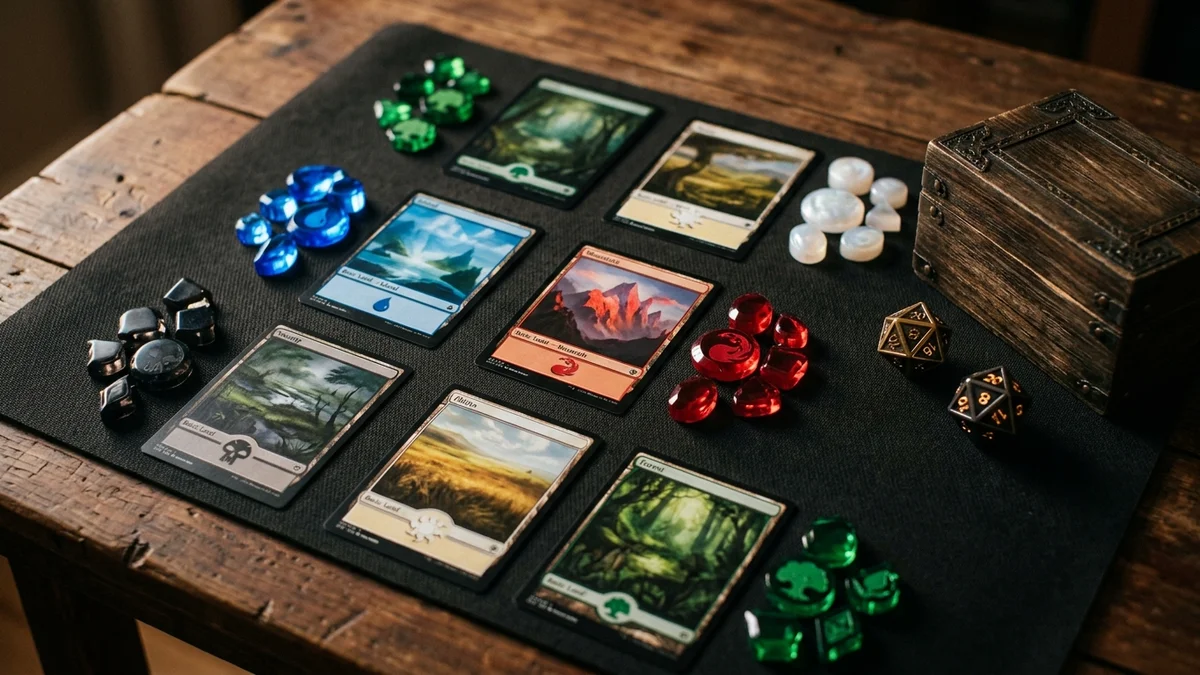
Adjust your total lands, 2-CMC rocks, and colored sources to compute on-curve probability.
Input your deck's land count, mana rock acceleration, and colored sources to compute exact on-curve casting probabilities.
Your colored mana base meets the Frank Karsten 90% consistency benchmark. You can reliably cast this spell on curve.
The Frank Karsten Commander mana base formula applies multivariate hypergeometric probability distributions to 99-card singleton libraries to compute the exact number of colored mana sources required to achieve a 90% probability of casting spells on curve (accounting for standard mulligan decisions, or ~85% under a strict no-mulligan draw). In a 99-card deck, hitting a single colored pip on Turn 1 requires 19 sources, a single pip on Turn 2 requires 19 sources, a double pip on Turn 2 (CC) requires 30 sources, a single pip on Turn 3 (2C) requires 18 sources (84.9% no-mulligan CDF), a double pip on Turn 3 (1CC) requires 28 sources (78.5% no-mulligan CDF), and a double pip on Turn 4 (2CC) requires 26 sources.
Constructing a reliable mana base is the single most critical engineering task in Commander. Unlike traditional constructed four-of formats where players can run four copies of key dual lands, a 100-card singleton format introduces massive variance. Players frequently construct three- or four-color decks with ambitious casting costs (such as casting Necropotence BBB on Turn 3 or Wrath of God 2WW on Turn 4) while running fewer than 15 sources of those colors.
The consequence is severe color screw: holding game-winning spells that cannot be cast. Under Dr. Frank Karsten's statistical models, mana sources include any card that reliably produces that color by the target turn—including basic lands, untapped duals (shocklands, true duals, painlands, bondlands), fetchlands, and two-mana rocks like Arcane Signet or Talismans. Every tapped land included in your 99 imposes an implicit tempo penalty, shifting your mana curve back by a full turn and decreasing your active win probability.
78.7% no-mulligan (90% with mulligans) to cast Turn 1 mana dorks or cantrips on curve.
84.9% without mulligans (Karsten's 90% target with mulligans) to cast 2C spells on curve.
78.5% without mulligans (Karsten's 90% benchmark with mulligans) for double-pip spells.
In addition, mana curve smoothing dictates that high-density colored spells require early fetchland priority over raw basic counts. In three-to-five-color commander decks, running 9 to 10 fetchlands acts as universal fixing, as a single Scalding Tarn or Polluted Delta can fetch dual lands of any constituent color, effectively counting as a source for all represented colors. By utilizing our interactive engine, you can immediately identify whether your manabase supports demanding commanders like Kess, Dissident Mage or Breya, Etherium Shaper.
Furthermore, utility land inclusion must be strictly budgeted against colored source minimums. Powerful utility lands such as Boseiju, Who Endures, Otawara, Soaring City, Urborg, Tomb of Yawgmoth, and Reliquary Tower offer tactical versatility, but colorless utility lands (like Strip Mine or Ancient Tomb) subtract directly from your colored pip quotas. Limiting colorless utility lands to fewer than 3 to 4 slots in multi-color decks prevents catastrophic color stalls during early turns.
By pairing your mana base optimization with our 1.0–10.0 Power Level Calculator and checking your pod's pacing in the Rule 0 Pod Matchmaker, you can eradicate dead hands, stabilize opening mulligan choices, and maximize your win equity across all 4-player Commander games.
Calculate the exact probability of drawing at least r colored sources by turn N using multivariate hypergeometric density.
Library population size (99 cards for standard Commander).
Total lands, fetches, and rocks producing the required colored mana.
Opening 7 hand cards plus draw steps on the play/draw (e.g. 9 cards by Turn 3 on the play).
Minimum colored mana threshold needed on that turn (e.g. r=1 for 2C, r=2 for 1CC).
Dr. Frank Karsten, Hall of Fame player and Ph.D. in mathematics, derived hypergeometric distribution tables specifically calibrated for 99-card Commander decks to calculate the exact colored source count required for a 90% probability of on-curve casting (e.g. 19 sources for C on Turn 1, 18 for 2C on Turn 3, 28 for 1CC on Turn 3).
Standard benchmarks recommend a baseline of 36–38 lands combined with 8–10 low-cost mana accelerants (CMC <= 2) like Sol Ring, Arcane Signet, Talismans, and Fellwar Stone. High-power cEDH lists drop to 28–32 lands by substituting dense positive mana rocks.
Yes. In Frank Karsten's mathematical model, an untapped fetchland (e.g., Polluted Delta) counts as a full colored source for both Blue and Black, assuming your library contains targets of both types (such as Underground Sea or Watery Grave).
Every tapped land delays your effective mana tempo by exactly one full turn. Having 10 or more tapped lands in a Commander deck lowers your functional on-curve probability, often leaving you a turn behind opposing pods.